
Rad Red (1991) · Track 14
Frozen in Time
A poignant ballad about fear and isolation. It captures the struggle of being trapped by past pain, yearning for freedom but paralyzed by the unknown. With heartfelt lyrics, it reflects the fragile balance between fear, hope, and love.
- Runtime
- 2:10
- Year
- 1991
- BPM
- 94
- Mood
- Paralyzing
CDSYNC91 00016-CD ALB-15ST US #T14
DigitalSYN91 00016-DD REI-35ST T14
The listening room
Let the echoes in.

Cherry Ember / 1991
Frozen in Time
Ready when you are
From the haunting first notes of the harpsichord, “Frozen in Time” envelops the listener in a chilling stillness, mirroring the paralyzing fear that inspired its creation. Released on Cherry Ember’s seminal debut album Rad Red, this poignant ballad stands as one of the most emotionally raw moments of her early career.
Written during her teenage years, Frozen in Time was born from Amber’s personal battle with agoraphobia, a condition that kept her confined within the same walls she felt powerless to escape. After the devastating loss of her mother at age 15—a time when she most desperately needed stability—Amber found herself at a crossroads. The safety of fear became suffocating, yet the idea of venturing out into an uncertain world felt just as overwhelming. What began as a private poem titled “Afraid to Live” soon transformed into a cathartic anthem of vulnerability and survival.
Lyrically, the song is a delicate balancing act of fear and longing:
“Frozen in time, afraid to fall,
Walls so high, she’s trapped by them all.”
With every line, Cherry Ember captures the suffocating loop of isolation and the ache of wanting more from life, yet feeling anchored by past wounds. The harpsichord’s stark, ghostly melody underpins the fragile narrative, lending the track a baroque eeriness that sets it apart from the grunge and pop dominating the early ‘90s.
But what makes Frozen in Time so enduring is its quiet hopefulness, whispered between the verses. Though the fear is ever-present, so too is the desire to break free, to heal, and to love despite it all:
“So scared of dying, afraid to live,
A fragile heart with love to give.”
More than three decades later, Frozen in Time remains a haunting reflection on grief, fear, and the small, brave steps we take toward freedom. It’s no wonder that Cherry Ember’s fans still cite it as one of her most deeply personal and relatable songs—a timeless ballad for anyone who’s ever felt locked in place, waiting for the strength to move forward.
Verse & chorus
The words inside.
She wakes up, heartbeats loud,Wrapped in fear, it’s her shroud,Counts each breath like it’s her last,Afraid to step out, haunted by the past.
Frozen in time, afraid to fall,Walls so high, she’s trapped by them all,Life’s a road she won’t roam,Terrified of the unknown.
So scared of dying, afraid to live,A fragile heart with love to give.
Sunlight peeks through closed blinds,But she says, “Maybe next time.”The world spins fast, leaves her behind,Locked in a loop she can’t unwind.
Frozen in time, afraid to fall,Walls so high, she’s trapped by them all,Life’s a road she won’t roam,Terrified of the unknown.
So scared of dying, afraid to live,A fragile heart with love to give.
The visual world
Album artwork.
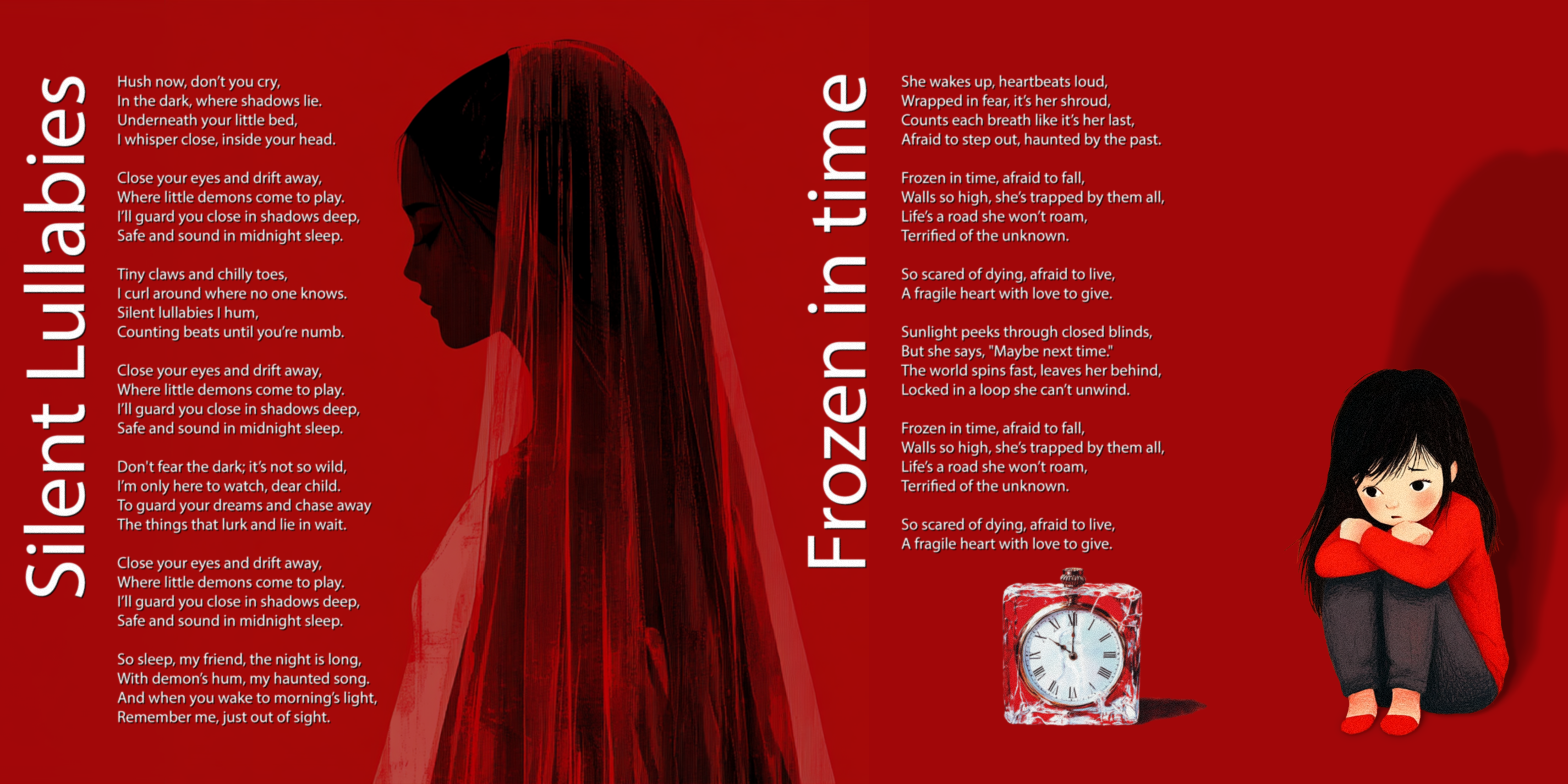
A crystal clock. An inward silence.
 View artwork
 This image presents a quiet, emotionally resonant moment, stripped down to its essential elements yet rich in meaning. A scene of profound stillness and solitude, it uses minimalist design to convey the weight of time, the ache of waiting, and the fragility of introspection. The entire background is consumed by a deep, uninterrupted red—a flat, textureless void that isolates the central figures and suspends them in an abstract space outside of time and place. This emptiness is not just visual, but emotional, amplifying the mood of the girl seated in its lower right corner.
Read the full artwork notes
She is curled in on herself, knees pulled tight to her chest, arms resting on top as if in a quiet act of self-protection. Her long black hair drapes slightly over her face, veiling her expression, though her downcast eyes and the faint downturn of her lips suggest sadness, weariness, or deep thought. Dressed in a red sweater that nearly vanishes into the surrounding crimson, she seems at once part of the space and apart from it—anchored only by the slightly brighter hue of her clothing. Her dark grey pants and matching red slippers lend her the appearance of being in a personal, familiar space, yet there’s no comfort in her posture. She doesn’t look at the clock beside her; she looks inward.
Just to her left rests a small, traditional clock encased in what appears to be a block of clear crystal or glass. It glows subtly against the red, refracting the light with a fragile elegance. The clock’s hands rest near 10:00, a time that may or may not hold significance, yet feels frozen—arrested in motion. The crystal casing suggests preservation, as though time itself has been sealed off, made untouchable. Its faint shadow grounds it slightly in the void, but not enough to dispel the surreal atmosphere. It exists, like the girl, more in symbolism than in space.
The color palette is dominated by reds—saturated, soft, and all-consuming. Against this backdrop, the pale tone of the girl’s skin and the white face of the clock emerge as points of fragile clarity, drawing the viewer’s focus. The red is emotionally charged, capable of representing both passion and stillness, warmth and suffocation. In this context, it feels heavy—like a curtain drawn over the world, thick with emotion and time unspoken.
The mood is meditative and steeped in melancholy. There’s no movement, only a lingering presence. The girl and the clock exist in parallel, each suggesting something more: a moment suspended, a memory preserved, a feeling that can’t move forward. Themes of isolation, the burden of time, and the vulnerability of emotional stasis ripple through the scene. The girl’s stillness, the way she curls into herself, the unreachable clock—all point to something deeply internal and unresolved.
Artistically, the piece merges anime-inspired delicacy with minimalist surrealism. The character is rendered with softness and care, while the environment is stark and abstract, using its emptiness to intensify the emotional core. The clean lines, smooth gradients, and focused palette heighten the feeling that we are not just witnessing a scene—but inhabiting an emotion. It is a moment captured not in time, but in feeling, and it lingers long after the eye moves away.
From her notebooks
From her
notebooks.
Cherry Ember
This Strange Endless Stage
When I wrote Frozen in Time, I was sixteen, and I felt like I was dissolving into my own silence. My world had grown so small after my mother died—four beige walls, a window I wouldn’t open, and the constant hum of my own dread. I had always been a sensitive kid, easily startled, afraid of thunder, clowns, even the echo of voices in long hallways. But after she passed, those little fears became big ones. They crept in and sat heavy on my chest each morning. I didn’t know it then, but I was living with agoraphobia. I didn’t even have a name for it. I just thought I was broken.
The poem that became Frozen in Time started as a scribble in a battered notebook I kept under my bed. I called it “Afraid to Live” because that’s exactly how it felt—like every moment was a choice between staying still or stepping into an abyss. I was terrified of both. My house became my shelter and my prison. I watched the seasons change from behind glass, the sunlight hitting the blinds like an invitation I couldn’t accept. It’s strange how something so intangible—fear—can be more binding than any locked door.
Musically, I knew the track had to sound like breath held too long. The harpsichord came to me in a dream, oddly enough. I loved its brittle, ghostly tone—how it clings to the air like frost on a windowpane. The beat is slow enough to feel suspended, as if time itself has stalled. That paralyzing mood was everything. I wanted the listener to feel exactly what I had felt: the ache of wanting to run and the terror that your legs won’t move. There’s love in the lyrics too, though—love I didn’t yet know how to give or receive. That last line, “A fragile heart with love to give”, was a wish more than a truth. I needed to believe I was still capable of that, even if I couldn’t leave my room.
Frozen in Time became the emotional cornerstone of Rad Red, even though it was the quietest track on the album. In a record full of rebellion and sonic fire, this song was my whisper in the storm. I didn’t write it to be brave. I wrote it because I had no other way to breathe. But in doing so, I found a kind of courage I didn’t know I had—the courage to put my fear into melody, to give my isolation a voice. And somehow, in sharing that voice, I started to find my way out.
Cherry Ember · This Strange Endless Stage
Across the years
Releases & formats.
Explore the full range of formats for this release, from timeless classics to modern editions. Whether you’re a collector or discovering it for the first time, find the version that suits your style:
Compact Disc
The original CD edition for crisp, high-quality audio.
Cassette
A nostalgic throwback with analog warmth, perfect for retro enthusiasts.
Digital Download
Instant access to the album in high-quality digital formats, compatible with your favorite devices.
Vinyl
The classic listening experience on high-grade vinyl, featuring rich sound and collectible artwork.
30th Anniversary Re-Release
A commemorative edition celebrating three decades, including remastered tracks and rare content.