
Red Room
Track Number: 04
Artist: Cherry Ember
Album: Rad Red
Year: 1991
Runtime: 2:11
Catalog (CD): SYNC91 00016-CD ALB-15ST US #T04
Digital: SYN91 00016-DD REI-35ST T04
Genre: Dream Pop
BPM: 117
Mood: Entrapment
Red Room
About
Cherry Ember’s “Red Room” from her 1991 debut album Rad Red stands as a haunting exploration of entrapment and the quiet desperation to escape. Deeply influenced by the ethereal stylings of Stevie Nicks, Ember crafts a soundscape that is equal parts dreamlike and oppressive. The song swirls with atmospheric melodies, delicate yet relentless, mirroring the claustrophobic imagery of crimson walls and poisoned air. Within its verses lies a portrait of someone suffocating inside their own confines, searching for cracks in the paint where freedom might seep through.
What makes “Red Room” so captivating is its ability to balance fear with fragile hope. The lyrics paint (quite literally) a scene of decay—a room bleeding red, where the air is thick with invisible dangers. Lines like “The paint, it peels like whispers, silent, deadly, slow,” suggest a creeping dread, an environment that has become toxic over time. And yet, through all the suffocation, there’s the repeated act of looking outward—the faded window, the hazy blue sky, the imagined realms beyond the heavy, red air. These moments of longing provide the heartbeat of the song, elevating it beyond despair and into a quiet rebellion against confinement.
Musically, “Red Room” leans into its introspective mood, with airy synths and whispered harmonies that drift like dust motes in the light. It’s easy to hear the Stevie Nicks influence in the vocal delivery—smoky, mysterious, and just on the edge of breaking free. By the final chorus, as Cherry sings “Beyond the red, beyond the red, / Floating free, floating free…” the track transcends its own weight, leaving listeners suspended somewhere between dream and reality, hoping for release right alongside her.
VERSE AND CHORUS
Song Lyrics
I’m living in the shadow of red walls, thick with dust and dreams,
The room is stained in color, where nothing’s as it seems.
The paint, it peels like whispers, silent, deadly, slow,
In every crack and corner, there’s a warning I don’t know.
Red room, red room, you hold me tight,
In layers of lead under crimson light.
I breathe you in, in shades unseen,
Dreaming of worlds where I’m free and clean.
I touch the faded window, the sky’s a hazy blue,
Outside is full of colors that I never knew.
I close my eyes and drift up, floating far and high,
To realms without the poison, no red to make me cry.
Red room, red room, you weigh me down,
In silent fears that grow and drown.
I’m tracing clouds in the ceiling’s cracks,
In a world of light, I won’t come back.
I’m reaching out to places, soft and spun with gold,
With air so sweet, no shadows cold.
Beyond these heavy colors, beyond this heavy air,
I live in dreams so distant, like no one knows I’m there.
Red room, red room, I’ll leave you soon,
In violet dreams under gentle moon.
A place where I’m alive, where colors breathe,
Beyond the red that’s poisoning me.
Beyond the red, beyond the red,
Floating free, floating free…
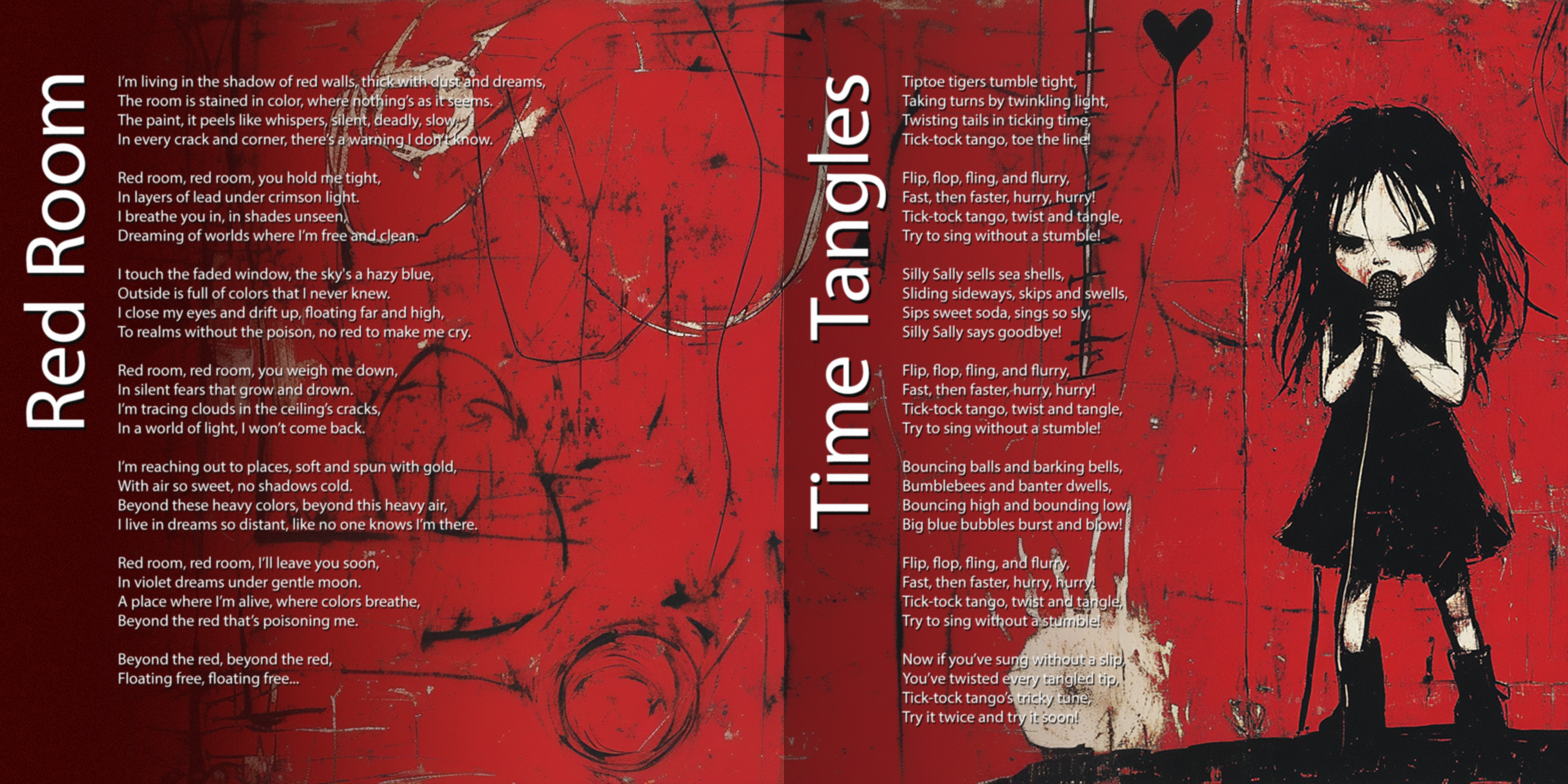
Album Artwork
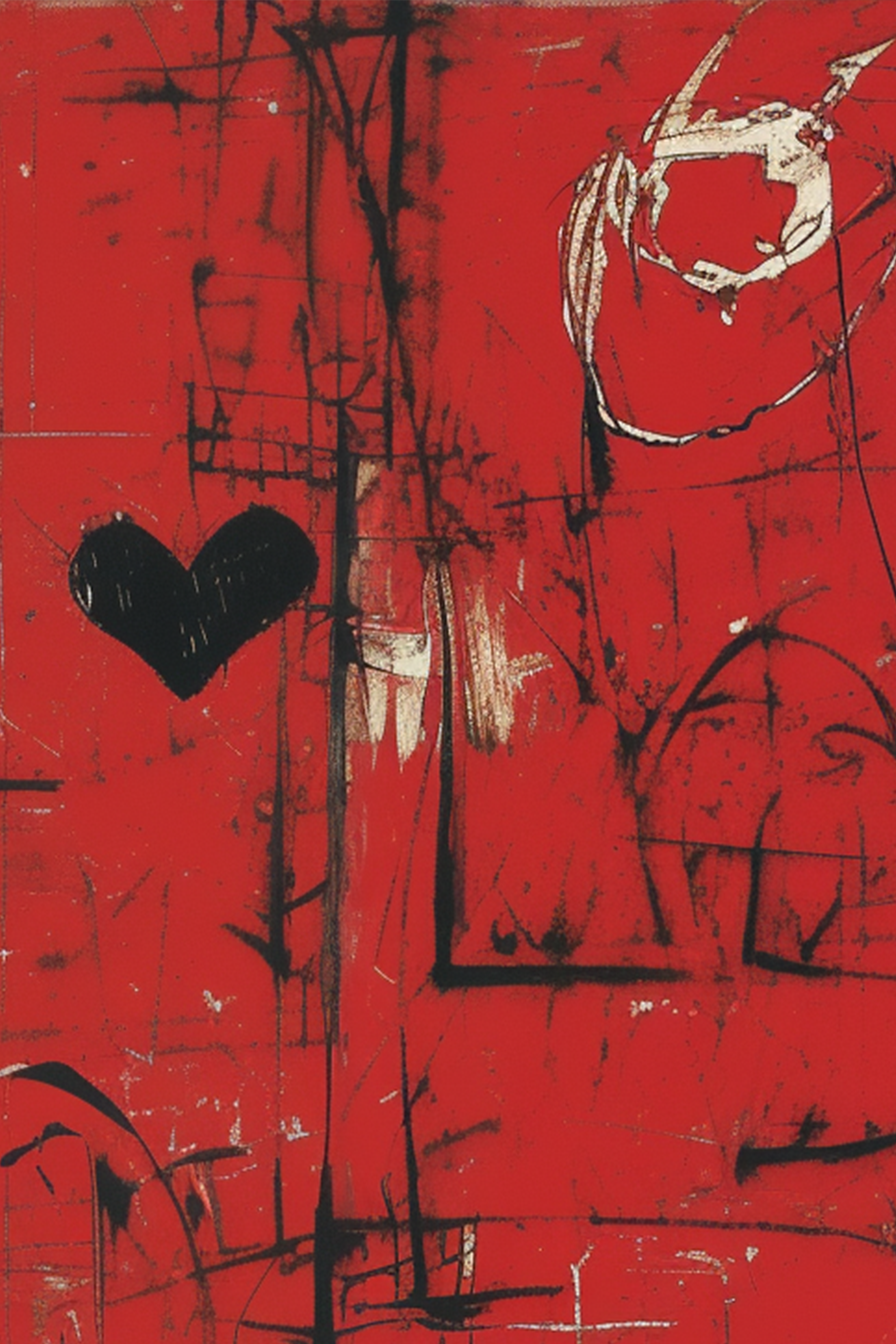
This artwork presents a raw and emotionally charged landscape, dominated by a deep, saturated red that engulfs the entire canvas. The red serves as more than just a backdrop—it is the emotional core of the piece, radiating intensity and suggesting powerful themes such as love, anger, blood, or passion. Its surface isn’t smooth or uniform; instead, it appears weathered, textured with patches that look scraped or faded, lending the image a sense of age and erosion. Flecks of white and distressed textures give the impression of something worn down, as if the painting itself has endured time or emotional strain.
Overlaying this turbulent red field are erratic black scribbles—lines that vary wildly in weight and sharpness. Some cut jagged paths across the canvas while others fade like faint sketches, creating a fractured lattice of chaotic energy. These lines hint at a structure, perhaps an unstable grid or broken architecture, yet they never form anything complete. The effect is both architectural and emotional, like a visual map of disarray—scrawled in haste, with the urgency of someone trying to make sense of turmoil or loss.
Near the center of the canvas, just slightly left, sits a solitary black heart—simple, solid, and instantly recognizable. Its edges are not pristine; instead, they feel hand-drawn, slightly uneven, as though marked in a moment of desperation or deep feeling. Amid the storm of red and black lines, the heart becomes a focal point—small but significant, a symbol of vulnerability suspended in chaos. Its placement and form suggest it may represent love lost, a fragile soul within disorder, or a quiet voice inside a noisy mind.
Scattered across the image are smudges and strokes of white and cream. These lighter markings provide contrast and depth, softening the harsher elements. Some resemble light bleeding through cracks, others appear like attempts to erase or redefine shapes. On the right side, there are hints of form—an outlined circle near the top right, perhaps the trace of a face or mask, and below it, curved lines that might suggest the faint impression of a seated figure. These ghostly remnants suggest memory, absence, or the trace of human presence breaking through the abstraction.
Altogether, the piece feels like a visual diary entry—fragmented, impulsive, and emotionally dense. The tension between structure and chaos, clarity and confusion, is palpable. Themes of heartbreak, longing, and emotional disorientation emerge, as if the artist has spilled their inner storm onto the canvas. With its rough textures, urgent markings, and symbolic core, the work echoes the spirit of abstract expressionism, offering not a narrative, but a feeling—raw, unresolved, and deeply human.
THE STORY BEHIND THE SONG
Unveiling the Inspiration and Themes
There’s a peculiar kind of fear that settles in your bones when you grow up thinking your bedroom walls might be trying to kill you. Mine were painted red—a deep, suffocating, almost too-warm red that seemed to pulse when the lights were low. I used to lie in bed staring at those walls, convinced the paint was full of lead, seeping into my lungs every time I breathed too deeply. I was just a kid, but the dread was real. You don’t need scientific proof when you’re young—your imagination is its own authority.
That room became my first prison and my first muse.
When I wrote “Red Room” for my debut album Rad Red in 1991, I was finally putting melody to the shadow that had followed me out of childhood. It wasn’t just about the fear of lead poisoning (though that fear haunted me more than I’d like to admit); it was about the feeling of being trapped inside something toxic and familiar. The walls weren’t just painted red—they were red. They bled into everything. The air. My skin. My dreams. And I wanted out.
There’s a part in the song where I sing, “The paint, it peels like whispers, silent, deadly, slow.” That line came to me in a half-sleep haze, back when I still lived at home. I’d watch the paint flake off near the vent and imagine it floating into my lungs like silent ghosts. That room had no ventilation, barely any light—just one window always clouded with condensation. But when the sun hit it right, it scattered colors across my floor like spilled glitter. That became the chorus. That became hope.
People often ask if “Red Room” is a metaphor for depression. And yeah, it is. But it’s also literal. It’s the air that felt heavy. The color that felt loud. The sense that I was growing up inside something that would rather keep me sick than let me go. Writing the song was my way of cracking open the window that never quite opened right.
Musically, I leaned into the ethereal because that’s how I survived it—by drifting, daydreaming, escaping inside my own head. Stevie Nicks was my north star. I’d put on “Sara” or “Storms” and feel seen in a way that red walls couldn’t smother. The synths in “Red Room” float like those daydreams—whispery, delicate, determined. I wanted the listener to feel what I felt: the oppression of confinement, yes, but also the sweetness of the imagined escape.
By the time I get to “Beyond the red, beyond the red, / Floating free, floating free…” I’m no longer singing from that room. I’m singing from the place I fled to in my mind. The place I had to believe existed, or I wouldn’t have made it out.
So yeah, “Red Room” is a song about fear. But it’s also about longing, imagination, and defiance. It’s about dreaming yourself into freedom when the door won’t open. And sometimes, that’s the most powerful kind of freedom there is.
– Cherry Ember, This Strange Endless Stage
Releases
Explore the full range of formats for this release, from timeless classics to modern editions. Whether you’re a collector or discovering it for the first time, find the version that suits your style:
-
- Compact Disc (1991) – The original CD edition for crisp, high-quality audio.
- Cassette (1991) – A nostalgic throwback with analog warmth, perfect for retro enthusiasts.
- 30th Anniversary Re-Release (2021) – A commemorative edition celebrating three decades, including remastered tracks and rare content.
- Digital Download (2016) – Instant access to the album in high-quality digital formats, compatible with your favorite devices.
- Vinyl (2018) – The classic listening experience on high-grade vinyl, featuring rich sound and collectible artwork.