
Whiskers in the moonlight
Track Number: 09
Artist: Cherry Ember
Album: Rad Red
Year: 1991
Runtime: 3:44
Catalog (CD): SYNC91 00016-CD ALB-15ST US #T09
Digital: SYN91 00016-DD REI-35ST T09
Genre: Indie Rock
BPM: 137
Mood: Bittersweet
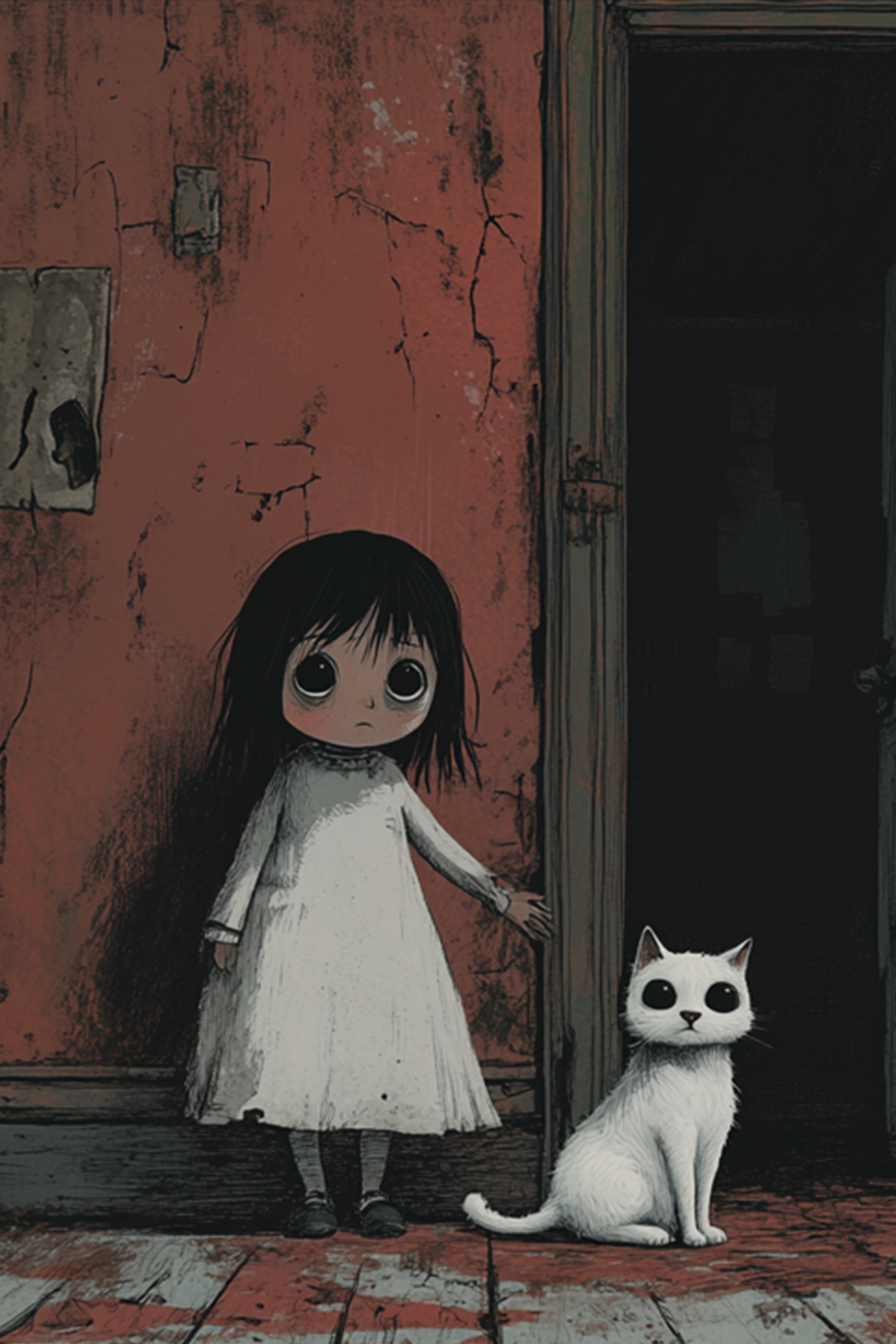
Whiskers in the moonlight
About
“Whiskers in the Moonlight,” released in 1991 on Rad Red, stands as one of Cherry Ember’s most hauntingly beautiful and deeply personal ballads. Unlike much of the edgier dream pop landscape of the early ’90s, this ethereal track floats delicately in the space between heartbreak and healing, weaving a bittersweet lullaby about love that transcends life itself. Written in the shadow of childhood grief, the song memorializes the quiet, unbreakable bond Cherry shared with her cat Tigger, who became her constant in a time when her world felt dangerously unstable. With her mother taken hostage and her father often away at work, Cherry turned to Tigger for solace. After his passing, the sense of abandonment became nearly unbearable—until small, spectral comforts began to arrive: the phantom brush of fur, the echo of a purr, the sensation of soft paws padding across creaky floors.
The lyrics of “Whiskers in the Moonlight” are threaded with delicate, nocturnal imagery—starlight spilling through a bedroom door, whispers and shadows moving through the night. Cherry captures that liminal feeling of half-dreaming, half-waking, where memory and imagination blur, and grief becomes a kind of ritual. It’s no surprise that, as a child, she turned to Ouija boards and midnight whispers in an attempt to reach the friend she had lost. The song channels that same yearning, inviting the listener into a world where love refuses to fade, where a simple purr might still be heard in the hush of leaves.
Musically, the track drifts like fog, with a slow, shimmering melody that feels as if it could dissolve at any moment. Cherry’s voice is tender and wistful, layered over airy synths and gentle reverb, creating a sense of weightlessness that perfectly mirrors the song’s ghostly theme. Over three decades later, “Whiskers in the Moonlight” remains a quietly devastating testament to the ways we keep our lost companions close, and how, sometimes, the smallest spirits leave the deepest echoes.
VERSE AND CHORUS
Song Lyrics
Soft little footsteps on the old wooden floor
She whispers a name she doesn’t use anymore
By the light of the stars through her half-opened door
She calls for the friend who was hers evermore
Whiskers in the moonlight, shadowed in the breeze
Purring echoes linger in the hush of leaves
A faint touch of fur, a glimmer in the night
Oh, spirit of her old friend, come close, take flight
She hums the lullaby they both used to know
Soft little hands in a midnight glow
Tiny paws that would follow, step by step
Now dance like whispers, a promise kept
Whiskers in the moonlight, shadowed in the breeze
Purring echoes linger in the hush of leaves
A faint touch of fur, a glimmer in the night
Oh, spirit of her old friend, come close, take flight
In the quiet she hears the softest sound
A brush of warmth that circles round
Her friend returns in a dreamlike haze
Together they drift in silvery waves
Whiskers in the moonlight, forever they’ll stay
A ghostly purr to guide her way
Through slumbered skies and starlit dreams
Bound by love, or so it seems
Album Artwork
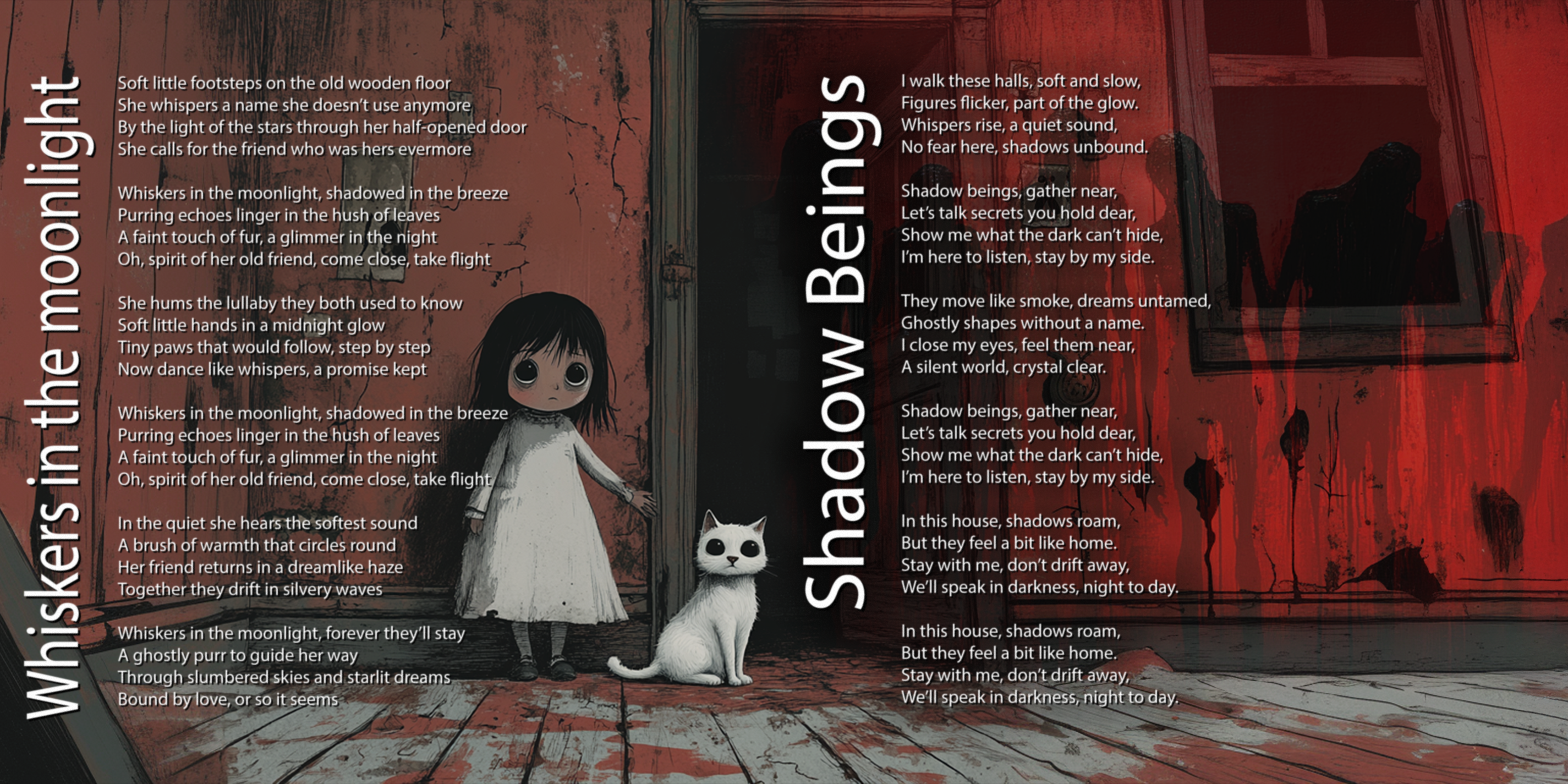
This image conjures a haunting and atmospheric scene, suspended somewhere between a dark fairytale and a lingering ghost story. Saturated in muted reds, deep blacks, and aged sepia tones, the setting exudes quiet dread. The viewer is drawn into a dilapidated room—its walls crumbling, its wooden floor cracked and streaked with ominous red stains, reminiscent of rust or old blood. Shadows crawl across every surface, bathing the space in an eerie, decayed light. There is no clear indication of time, only the oppressive sense that this place has long been abandoned to silence and memory.
In the foreground, a young girl stands just to the left of an open doorway, her presence as still and ghostlike as the air around her. She wears a simple white nightgown that glows softly against the darkness, her scuffed black shoes planted on the stained wood. Her pale face, framed by long, unkempt black hair, is eerily expressionless. Her impossibly wide, deep black eyes stare blankly forward—calm, detached, and unsettlingly composed. One hand rests gently on the head of a white cat at her feet, the other hanging loosely by her side. The pose is frozen, ritualistic almost, as if she has been standing like this for a long time—waiting, watching, or perhaps welcoming something.
The white cat, with the same wide black eyes as the girl, sits still and alert beside her. It mirrors her in appearance and posture, its pristine fur creating a stark visual contrast with the dark, rotting room. More than just a pet, the cat feels like a familiar—a guardian spirit or silent sentinel that shares the girl’s eerie calm. Together, they form a strange, ghostly pair: untouched by the decay around them, yet seemingly of it.
Behind them, the doorway yawns open into a thick, oppressive darkness. Inside, vague human-like silhouettes stand just barely visible, faceless and immobile. They bleed into the shadows, their forms elongated and smeared with faint red hues. The figures don’t move, but their presence is suffocating—watchful, unknowable, and deeply malevolent. This abyss beyond the door feels like another world entirely, or perhaps the same world, but long forgotten by the living.
To the right, the broken window offers no escape. Beyond the cracked glass, more shadowy forms press in, barely distinguishable through the red-stained grime. The walls around it are etched with scratches and stains, some faintly resembling smeared handprints. Everything in the space whispers of long-passed events, of stories never told but deeply felt. It’s a room full of silence—and something sinister dwelling just beneath it.
The mood is one of quiet, unbearable stillness. Nothing is actively threatening, yet a deep sense of unease permeates every detail. The girl and her cat are not frightened; they seem to belong to this place, as much a part of its eerie atmosphere as the shadows themselves. Themes of innocence surrounded by darkness, of haunted isolation and silent guardianship, echo through the composition. It’s as if the child and her companion are both victims and keepers of this haunted space, caught in a moment that either precedes or follows something terrible—and refuses to let it go.
Stylistically, the artwork blends gothic horror and dark fairytale elements with a gentle, storybook simplicity. The palette—limited mostly to reds, blacks, and whites—amplifies the emotion without overwhelming the eye. Despite the visual softness, the scene holds a chilling weight. The girl’s delicate design and the cat’s stillness contrast sharply with the decaying room and shadowed figures, making the entire image feel like a beautiful nightmare—one that lingers long after you’ve looked away.
THE STORY BEHIND THE SONG
Unveiling the Inspiration and Themes
I was eight when I wrote the poem that would one day become Whiskers in the Moonlight. Back then, it wasn’t a song, just a collection of scribbled verses pressed between the pages of a tear-streaked notebook I kept under my pillow. Tigger had just died—my only real companion in a world that, to me, felt terrifyingly hollow. My mother had been taken hostage overseas, my father buried himself in work to cope, and I was left in a house that creaked with emptiness. But Tigger had always been there—perched on windowsills, curled up by my side, blinking slowly like he understood everything I couldn’t say aloud. His absence felt like a gaping hole in the fabric of my tiny universe.
That’s when the dreams started. I’d feel the weight of paws at the foot of my bed, the ghost of a purr beside my ear, like he hadn’t really left—just slipped into another form. I used to lie awake whispering his name into the dark, half hoping, half believing he might come back if I wished hard enough. My childish rituals—drawing stars on the windowpane with my breath, placing his old collar beneath my pillow, fumbling with a Ouija board I didn’t really understand—were my way of holding onto him. I think, deep down, I wasn’t trying to summon a ghost so much as I was trying to keep a promise: that I wouldn’t forget him. That he wouldn’t become just another thing I had lost.
Years later, when I was recording Rad Red, I found that old poem again. The words were faded, but they carried the weight of everything I had felt—grief, love, longing, and that fragile belief in something beyond this world. Turning it into a song felt like honoring the girl I had been, and the cat who had kept her whole. I slowed the tempo, leaned into the hush, and let my voice carry the ache of all those silent nights. When I sing it even now, decades later, I still feel Tigger close—like he never really left, just melted into the moonlight.
– Cherry Ember, This Strange Endless Stage
Releases
Explore the full range of formats for this release, from timeless classics to modern editions. Whether you’re a collector or discovering it for the first time, find the version that suits your style:
-
- Compact Disc (1991) – The original CD edition for crisp, high-quality audio.
- Cassette (1991) – A nostalgic throwback with analog warmth, perfect for retro enthusiasts.
- 30th Anniversary Re-Release (2021) – A commemorative edition celebrating three decades, including remastered tracks and rare content.
- Digital Download (2016) – Instant access to the album in high-quality digital formats, compatible with your favorite devices.
- Vinyl (2018) – The classic listening experience on high-grade vinyl, featuring rich sound and collectible artwork.