
Hypnagogia
Track Number: 11
Artist: Cherry Ember
Album: Rad Red
Year: 1991
Runtime: 2:09
Catalog (CD): SYNC91 00016-CD ALB-15ST US #T11
Digital: SYN91 00016-DD REI-35ST T11
Genre: Psychedelic Rock
BPM: 144
Mood: Unease
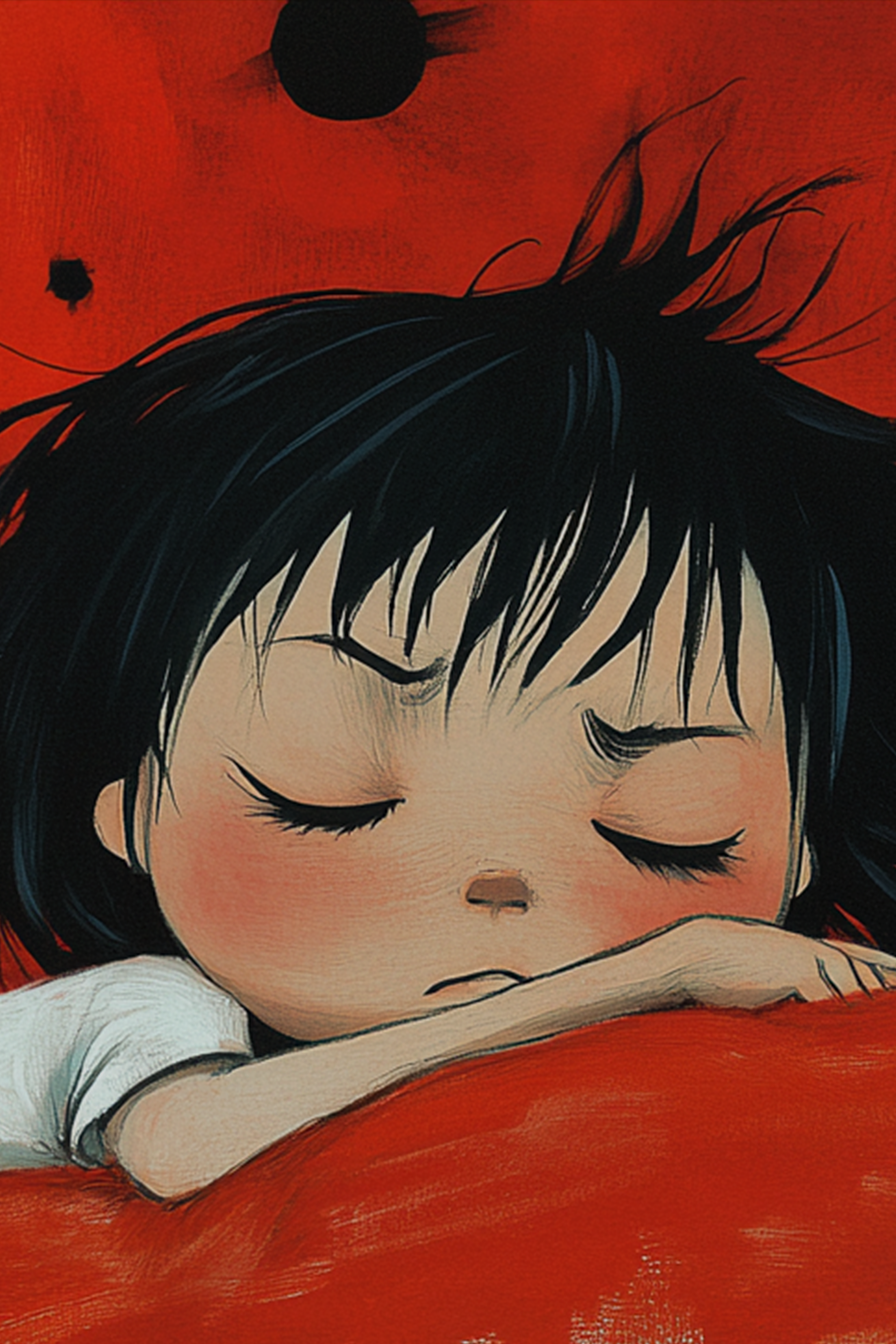
Hypnagogia
About
Released in 1991, “Hypnagogia” by Cherry Ember stands as one of the most unsettling yet beautifully hypnotic entries in her catalog. True to its name, the track immerses listeners in the disorienting threshold between wakefulness and sleep—a fragile, weightless state where reality fractures and the mind becomes its own haunted landscape. Driven by reverb-drenched guitars, airy synth layers, and Cherry’s distant, almost whispered vocals, the song drifts like a fog over dimly lit terrain, never quite letting the listener know which way is up. There’s a steady unease threading through every note, a quiet dread wrapped in dreamlike melodies that feel both intimate and otherworldly.
“Hypnagogia” was deeply personal for Cherry Ember, whose struggles with sleep disorders often left her trapped in vivid hallucinations that blurred the boundary between the waking world and the surreal. This song, like many in her body of work, functions as both confession and catharsis. The lyrics describe the slow pull into an unseen abyss—“Whispers start to twist and crawl, / Shadows paint the bedroom walls”—while the swirling shoegaze instrumentation amplifies the sensation of being caught, weightless and powerless, in the current of an unrelenting descent.
Listening to “Hypnagogia” feels like falling through velvet darkness, where Cherry’s ghostly voice guides you deeper into the space where nightmares bleed into reality. It’s a song that doesn’t chase the light, but instead lingers in the liminal, embracing the spectral figures and echoing fears that most of us try to leave behind when we close our eyes. Even decades later, its haunting mood and ethereal soundscape make it a standout piece of early ’90s psychedelic indie rock—an elegy for the nights Cherry Ember never fully escaped.
VERSE AND CHORUS
Song Lyrics
In the quiet, in the dark, she waits,
Eyes closed, but her mind won’t fade.
Falling slowly, sinking low,
To a world she’s afraid to go.
Whispers start to twist and crawl,
Shadows paint the bedroom walls,
Caught between the real and dreams,
Nothing is quite what it seems.
When she falls, into the light,
Echoes chase her through the night,
Shapes and voices, close and near,
Hypnagogic fears appear.
Can’t wake up, can’t run away,
Lost in the edge of night and day.
Just one step, and she’s pulled below,
In a world only shadows know.
Album Artwork
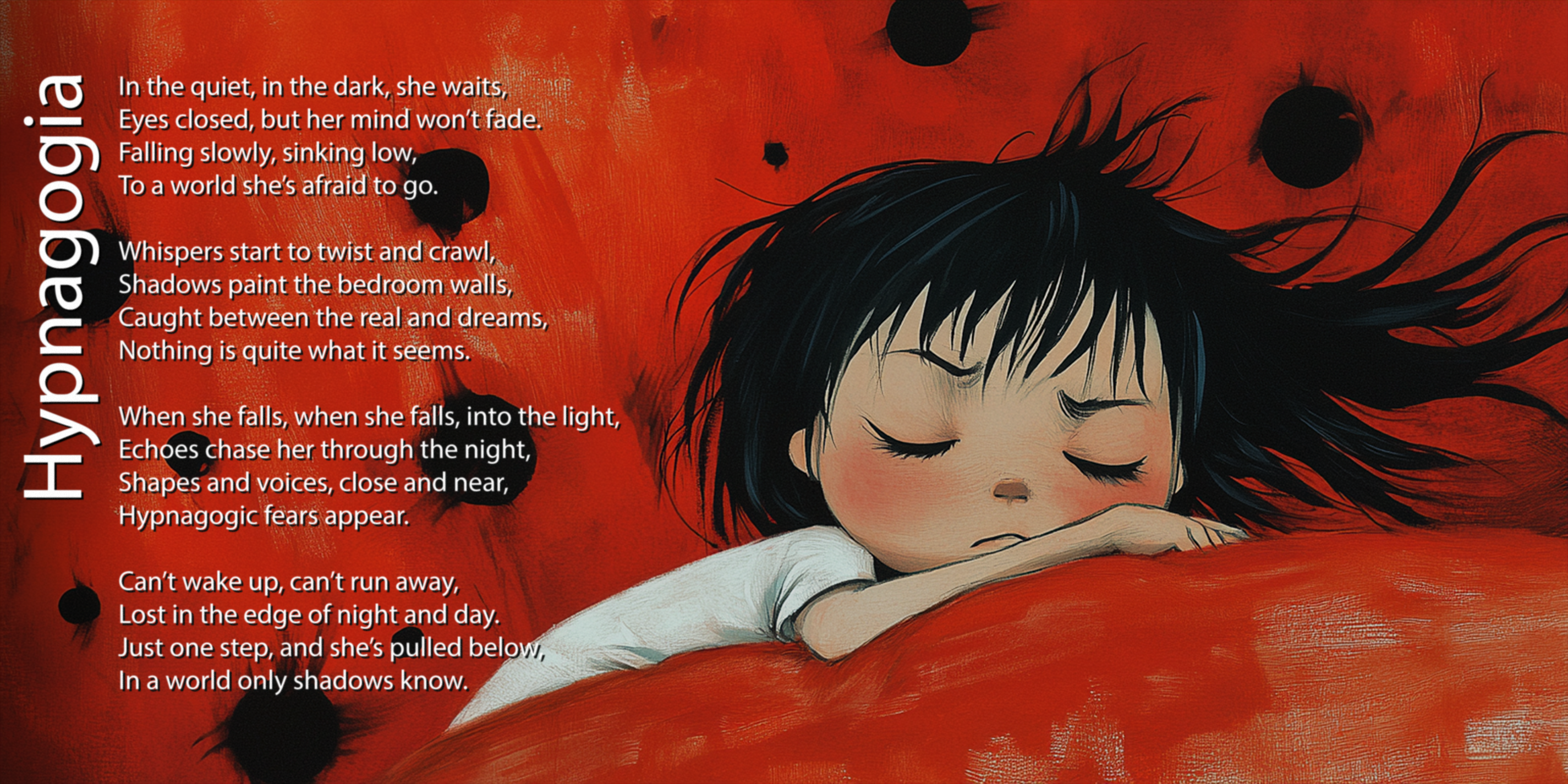
This image portrays a deeply evocative and melancholic moment, where quiet vulnerability rests uneasily against a surreal, consuming backdrop. Minimalist in composition but rich in atmosphere, the artwork uses a striking palette of red, black, and white to create a mood that feels suspended between serenity and subtle dread. At the heart of the scene is a sleeping girl—delicate, peaceful, yet surrounded by a world that feels strangely alive and quietly ominous.
The girl lies in the foreground, her head gently resting on a large, cushioned red surface that dominates the frame. Only part of her body is visible, directing attention to her pale, sleeping face and the soft bend of her arm beneath her. Her eyes are closed, lips faintly pursed, and her expression carries a peacefulness tinged with something deeper—perhaps uncertainty, or the quiet surrender of someone drifting through an uneasy dream. A blush colors her cheeks with warmth, but it does little to disturb the fragile calm etched across her features.
Her jet-black hair fans outward, delicate strands trailing into the surrounding space like tendrils of ink in water. It floats gently to the right of the frame, suggesting movement—either from a breeze, or the suspended weightlessness of dream or underwater drift. She wears a plain white garment, unadorned and soft, which adds to the sense of innocence and vulnerability, placing her in stark contrast to the vivid chaos around her.
That chaos comes in the form of the setting itself—a rich, painterly red expanse textured with soft brushstrokes and irregular depth. The red is bold, enveloping, and almost oppressive, acting not just as background but as emotional force. Scattered across this red field are strange, irregular black spots—circular, yet soft at the edges, as if inked or burned into the surface. They appear random, yet each one feels intentional, like abstract bruises spreading across a dreamscape. Their unsettling presence gives the impression of something decaying, growing, or slowly taking over.
The surface beneath the girl seems soft and tufted, like worn upholstery or an enormous cushion, though it remains abstract and ambiguous—part object, part environment, maybe even something alive. The way the brushstrokes move across it gives it breath, a pulse, as if the girl has fallen asleep on something ancient and sentient. The entire composition becomes a place of rest and warning, of stillness under pressure.
The mood is quietly devastating—serene on the surface, but heavy with an undercurrent of tension. There’s no violence or chaos, only a dreamlike pause, filled with exhaustion and a strange, creeping unknown. Themes of isolation, surrender, and fragile peace emerge: the girl sleeps amid what could be symbolic of trauma, infection, or something unspoken spreading just beneath consciousness. Yet she remains unbothered, untouched. There’s a haunting beauty in that contradiction.
Visually, the piece combines anime-inspired character design with expressive, painterly abstraction. The girl’s precise detailing contrasts with the rawness of the background, creating a powerful dissonance that amplifies the dreamlike quality. The limited palette of red, black, and white is bold and immersive, reinforcing the emotional focus and visual cohesion. It’s a scene that lingers—unsettling, tender, and strangely comforting, like a lullaby humming through a storm.
THE STORY BEHIND THE SONG
Unveiling the Inspiration and Themes
When I first came across the word hypnagogia, I was halfway down a strange rabbit hole about Dario Argento’s Phenomena. I’d only watched the film because I was obsessed with Labyrinth as a teenager—Jennifer Connelly was otherworldly in it, and I was desperate to see more of her early work. Phenomena was a fever dream, all insects and telepathy and unnerving atmosphere. Somewhere in an old interview or fan discussion, someone described her character’s dream states as hypnagogic. I paused the VHS, grabbed my notebook, and underlined the word like it had just unlocked something.
Back then, I didn’t have a name for the episodes I was having at night—those moments where my body was paralyzed, but my mind was still flickering with sound and vision. Shapes moving in the corner of my eye, voices whispering nonsense just out of reach, a presence sitting on my chest that evaporated the moment I fought to move. It wasn’t sleep, and it wasn’t waking. It was limbo. Hypnagogia. Finally, I had a word for that fragile, terrifying borderland I kept slipping into.
“Hypnagogia” the song came to me like a fog that wouldn’t lift. I was layering these airy synth lines that felt like gauze, like something soft but suffocating, and the guitars came next—drenched in reverb, slow and deliberate, like footsteps down a hallway that isn’t really there. I remember whispering the lyrics into an old four-track recorder, my voice barely above the hiss of the tape. It didn’t feel right to sing them loud. They weren’t meant to be shouted. They were confessions—fragments from the threshold where I lost myself night after night. Whispers start to twist and crawl / Shadows paint the bedroom walls—it was all straight from those liminal hours, where fear is gentle but absolute.
Releasing it in 1991 felt vulnerable in a way my earlier songs hadn’t. This wasn’t just a vibe or a persona; this was me trying to map a haunted part of my own brain. The rhythm wasn’t about motion—it was about the slow acceleration of dread. There’s something steady about fear when it comes every night. “Hypnagogia” is that descent, that soft panic. It’s the sound of being too tired to scream, too awake to dream. Even now, people tell me it gives them chills. That makes me smile. I didn’t write it to comfort anyone. I wrote it to say: this is the place I go when I close my eyes—and I’m still trying to find the way out.
– Cherry Ember, This Strange Endless Stage
Releases
Explore the full range of formats for this release, from timeless classics to modern editions. Whether you’re a collector or discovering it for the first time, find the version that suits your style:
-
- Compact Disc (1991) – The original CD edition for crisp, high-quality audio.
- Cassette (1991) – A nostalgic throwback with analog warmth, perfect for retro enthusiasts.
- 30th Anniversary Re-Release (2021) – A commemorative edition celebrating three decades, including remastered tracks and rare content.
- Digital Download (2016) – Instant access to the album in high-quality digital formats, compatible with your favorite devices.
- Vinyl (2018) – The classic listening experience on high-grade vinyl, featuring rich sound and collectible artwork.