
Midnight Thunder
Track Number: 12
Artist: Cherry Ember
Album: Rad Red
Year: 1991
Runtime: 5:28
Catalog (CD): SYNC91 00016-CD ALB-15ST US #T12
Digital: SYN91 00016-DD REI-35ST T12
Genre: Indie Rock
BPM: 175
Mood: Vulnerability
Midnight Thunder
About
“Midnight Thunder,” the haunting centerpiece of Rad Red (1991), remains one of Cherry Ember’s most emotionally raw and eerily prophetic songs. Blurring the line between dream and waking terror, the track captures that fragile state of vulnerability found only in the dead of night—when the mind becomes a storm all its own. Wrapped in layers of reverb-soaked guitars and ambient textures, Cherry’s ethereal vocals sound distant, almost as though she’s singing from somewhere just out of reach, lost inside the very phantom storm she’s describing. With imagery of gunshot-like blasts in the night and spectral thunder rolling overhead, the song paints a vivid portrait of sleepless fear, the kind that feels both irrational and all-consuming.
What began as Cherry’s attempt to process the strange, jarring phenomenon of “exploding head syndrome”—those terrifying, imaginary bursts of sound that would wake her just as she drifted off—has since become one of the most talked-about moments in her catalog. In hindsight, fans can’t help but connect its lyrics to the tragedy of her death on January 1, 2000, when a stray bullet from a Y2K celebration struck her as she slept. The parallels are chilling. A song about an imagined gunshot, a restless night, and an unseen force stealing her peace somehow foresaw the unimaginable. It’s widely remembered now as one of the many eerie “premonitions” scattered throughout her brief but brilliant career, and Midnight Thunder carries an almost sacred weight because of it.
Even before her passing, this track was notoriously difficult for Cherry to perform live. She openly wept during the original recording session, and audiences recall the rare, trembling moments when she’d attempt it on stage, often wiping away tears mid-verse. The thunder that bookends the song—rolling in strong at the start, echoing into silence by the end—serves as both a literal and symbolic heartbeat, mirroring the tension between calm and chaos, life and death. More than three decades later, Midnight Thunder is not just a dream pop masterpiece; it’s a chilling echo from an artist who seemed to sense the storm long before it arrived.
VERSE AND CHORUS
Song Lyrics
Lying in the darkness, heavy eyes, I start to drift
When a flash ignites my silence, like a switch, it flips
It’s in my head, but it feels so real
Like a gunshot in a dream, waking me to steel
A phantom blast, a broken sky
The thunder rolls, but there’s no cry
Just me, alone in this waking fright
Haunted by the noises of the night
Oh, midnight thunder, cracking in my brain
A shadow lightning I can’t explain
You haunt my sleep, you steal my rest
Exploding silence in my chest
I tell myself it’s nothing, just a trick my mind can play
But when I close my eyes, it’s there, no way to keep it away
I brace myself, I hold my breath
Anticipating a sound that’s worse than death
There’s no one here, no breaking glass
Just echoes in this empty past
My heartbeat pounding like a drum
Waiting for the next explosion to come
Oh, midnight thunder, cracking in my brain
A shadow lightning I can’t explain
You haunt my sleep, you steal my rest
Exploding silence in my chest
Is it my fears? Or memories buried deep?
Is it a ghost in my mind that won’t let me sleep?
They say it’s just a trick, a sensory lie
But it feels like a storm tearing through my mind
Oh, midnight thunder, cracking in my brain
A shadow lightning I can’t explain
You haunt my sleep, you steal my rest
Exploding silence in my chest
Lying here in the quiet, afraid to drift away
In the dark, I wait for the break of day
With each heartbeat, the silence grows
And I wonder if tonight, the thunder knows…
Album Artwork
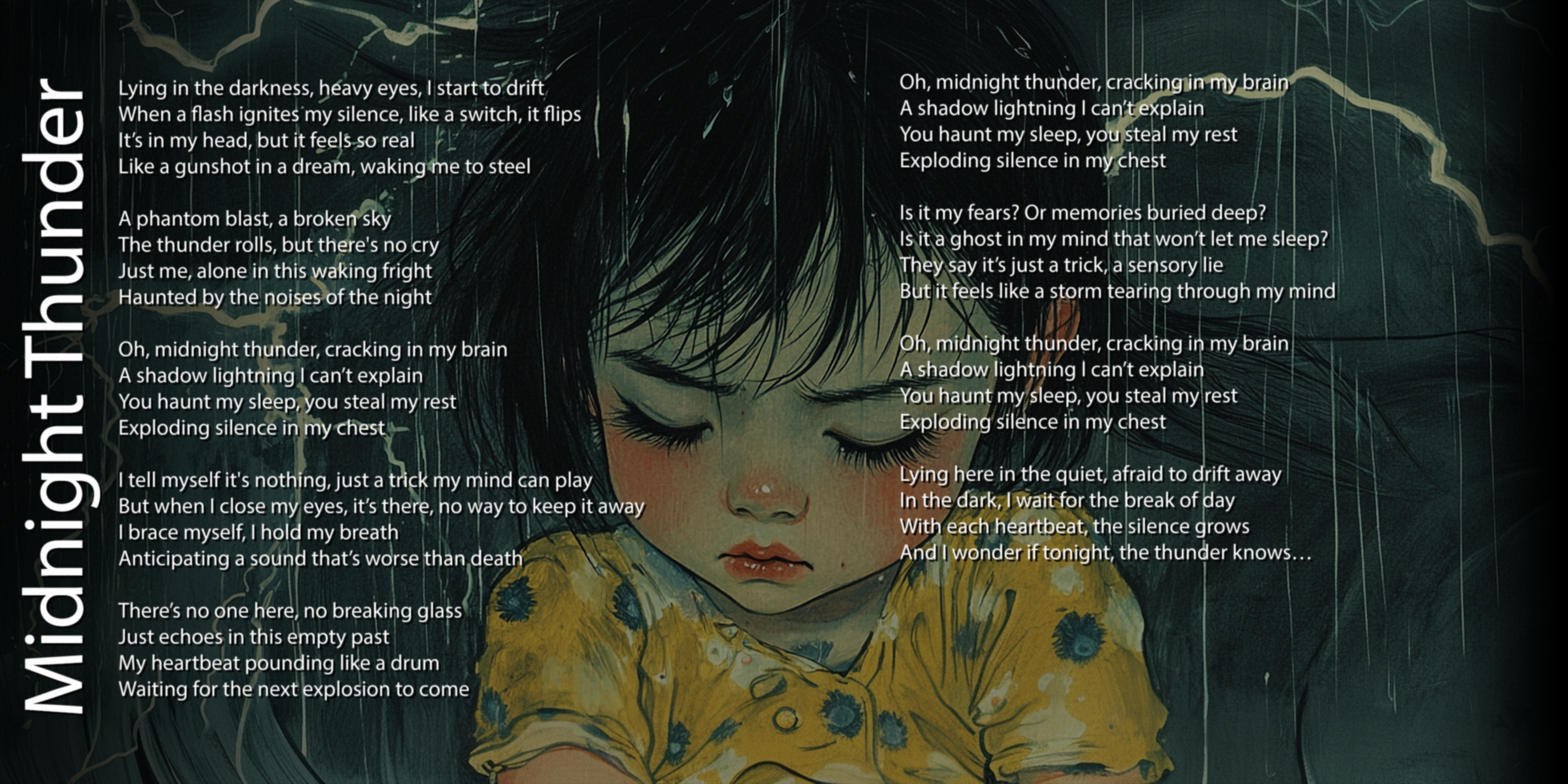
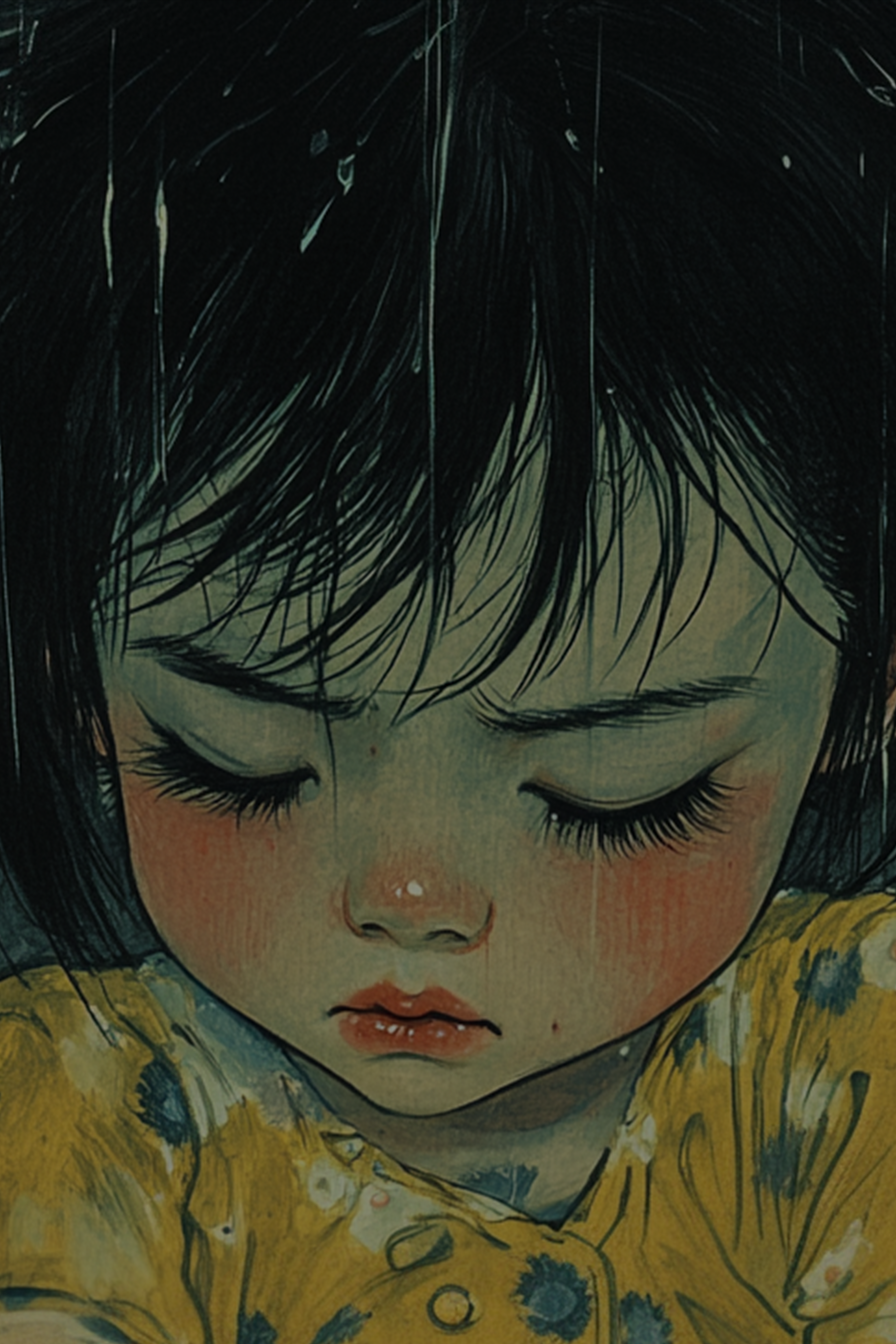
This image is a deeply moving portrait that captures a quiet storm of emotion through subtle expression and atmospheric detail. Centered on a young girl who appears no older than six or seven, the scene radiates vulnerability, solitude, and a haunting kind of calm. Her posture is gentle, her head slightly bowed, eyes softly closed—not in sleep, but in introspection, as if she’s listening to a sorrow only she can hear. The delicate curve of her lips, drawn down at the corners, suggests exhaustion or sadness, while the faint crease between her brows hints at a burden held silently within.
Her pale skin carries a tender blush, like the trace of cold or tears. A single droplet—a tear or perhaps a raindrop—rests beneath her eye, catching the dim light. Her jet-black hair, damp and tousled, clings to her forehead in wispy strands, fluttering faintly as though the air itself is unsettled around her. Framed by long, dark lashes, her closed eyes draw the viewer in, inviting empathy without a word. She wears a soft yellow dress, patterned with faded blue flowers. The fabric, rumpled and wet, clings to her small form. Its warm hue contrasts poignantly with the storm-dark backdrop, evoking the fragility of hope in a world heavy with sadness.
The background is drenched in deep blues, grays, and blacks, creating the feeling of being submerged in the heart of a storm. Rain falls in fine, ghostly streaks, washing across the scene like silk threads—gentle, but unyielding. It’s a rain that feels emotional as much as physical, a steady downpour of feeling. Behind her, jagged veins of lightning tear through the sky, bright and electric, illuminating the dark with sudden, chaotic beauty. The lightning seems to frame her, not threatening, but echoing her quiet intensity, as though the storm itself is a reflection of her inner world.
The mood is one of melancholic stillness—a serenity shaped by resilience rather than peace. The girl appears utterly alone, with no shelter in sight, yet she sits calmly within the storm as if she’s grown familiar with its rhythm. The contrast between her soft presence and the violent weather evokes a powerful metaphor: that the storm is both around and within her. She is small, fragile, yet unmoved. Her stillness becomes an act of quiet defiance.
Themes of inner turmoil, solitude, and strength emerge with aching clarity. Her delicate frame, framed against the vastness of the storm, speaks to the depth of emotion children can carry—silent and unseen. The yellow dress becomes a symbol of innocence surviving within darkness, a single point of warmth in a world of cold. She endures not by force, but by stillness, by allowing the storm to pass through her without breaking her.
Rendered with a blend of anime-inspired precision and painterly atmosphere, the image uses soft brush textures and moody lighting to build emotional depth. The rain’s translucency, the subtle blending of shadows, and the carefully controlled palette—muted blues and blacks, anchored by the luminous yellow—create a dreamlike yet grounded visual experience. It’s a portrait that lingers in the viewer’s heart, quiet and powerful, like the echo of a memory you can’t quite let go.
THE STORY BEHIND THE SONG
Unveiling the Inspiration and Themes
The truth is, I thought I was haunted. Not by ghosts in the attic or anything like that, but by sound. Invisible, impossible sound. Something only I could hear. The first time it happened, I was sixteen, lying in the dark in my parents’ house, drifting, and then—crack. Like someone had fired a gun right beside me. My whole body jerked like I’d been shocked, but the house was still, the night silent, nothing but the sound of my own pulse pounding in my ears. It happened again and again, always just before sleep took me. I started to fear falling asleep, not because of nightmares, but because of the way my brain seemed to revolt against the idea of rest.
Years later, I’d learn other people had experienced the same thing—that there was even a name for it. But I never knew it back then. I wasn’t interested in clinical explanations. All I knew was how it felt: like something sacred and terrifying was trying to claw its way out of my chest. That’s where “Midnight Thunder” came from. It was me trying to make sense of that fracture between silence and chaos. To give a melody to that violence that lived inside the stillness of night.
Recording that track for Rad Red was brutal. I cried—full-on, snot-nosed cried—in the studio. Not just from the memory of those nights, but from the strange feeling that I was singing about something bigger than just a sleep glitch. It was like I was channeling some future storm I couldn’t quite see yet, only feel coming in the distance. Every time I got to the chorus, I felt like my chest was caving in. That line—exploding silence in my chest—it wasn’t poetic. It was real. I lived that. Over and over.
– Cherry Ember, This Strange Endless Stage
Releases
Explore the full range of formats for this release, from timeless classics to modern editions. Whether you’re a collector or discovering it for the first time, find the version that suits your style:
-
- Compact Disc (1991) – The original CD edition for crisp, high-quality audio.
- Cassette (1991) – A nostalgic throwback with analog warmth, perfect for retro enthusiasts.
- 30th Anniversary Re-Release (2021) – A commemorative edition celebrating three decades, including remastered tracks and rare content.
- Digital Download (2016) – Instant access to the album in high-quality digital formats, compatible with your favorite devices.
- Vinyl (2018) – The classic listening experience on high-grade vinyl, featuring rich sound and collectible artwork.