
Silent Lullabies
Track Number: 13
Artist: Cherry Ember
Album: Rad Red
Year: 1991
Runtime: 4:47
Catalog (CD): SYNC91 00016-CD ALB-15ST US #T13
Digital: SYN91 00016-DD REI-35ST T13
Genre: Experimental Electronic
BPM: 104
Mood: Terrifying
Silent Lullabies
About
“Silent Lullabies” by Cherry Ember, from her haunting 1991 album Rad Red, is a chilling nocturne wrapped in cryptic whispers and ominous harmonies. The track is often regarded as the most terrifying entry in her discography, plunging listeners into the eerie hush of nightfall where protection and peril blur into one. Driven by creeping neoclassical darkwave instrumentation—delicate piano notes unraveling like cold fingers and low, droning strings—the song feels less like a lullaby and more like a warning murmured from under the bed. Cherry Ember’s voice is spectral and intimate, as if she’s leaning in too close, reciting ancient rhymes from the shadows just beyond your sight.
At its core, Silent Lullabies tells the story of a young girl haunted by recurring visions of a veiled, bloodied bride—a ghastly image of her future self, forever lingering in the corners of her childhood home. Throughout her youth, Cherry was known for her attempts to befriend the Shadow Beings that stalked her old house, but this particular apparition remained untouchable until the eve of her adolescence, as she prepared to leave her childhood behind. The figure of the Bride became a dark metaphor, reflecting Cherry’s deep-seated fears of adulthood, womanhood, and the societal expectations looming ahead. That the song is voiced from the Bride to her younger self only heightens the unease, as if the ghost of her future is coaxing her into uneasy slumber, threading comfort with dread.
Many fans later tied the imagery of Silent Lullabies to the tragic end of Cherry Ember’s life—her untimely death during a Y2K celebration in 2000, struck by a stray bullet just as the new millennium began. Although she never married, the Bride motif came to symbolize the life milestones she feared, rejected, or never had the chance to fulfill. In this way, Silent Lullabies became an accidental prophecy—a demonic nursery rhyme that hints at fate’s quiet, inevitable advance. Another popular interpretation among longtime listeners suggests the Bride figure wasn’t just a distorted vision of Cherry’s future self, but perhaps a premonition of her own mother, who passed away from a brain tumor when Cherry was just 15. The imagery of the veiled woman with a bloodied head, softly watching over the child in the night, is thought to reflect the looming, unspoken presence of her mother’s illness during Cherry’s early adolescence—a hidden dread whispering beneath the surface long before loss became real. In this reading, Silent Lullabies transforms into a spectral exchange between mother and daughter, a chilling yet strangely gentle assurance that the night is never truly empty—that somewhere beyond the veil, someone is still lingering, still guarding, still humming softly in the dark. It’s not merely a song to play when the lights go out—it is the darkness itself, curling around you like a shadow, staying long after the final note has vanished, quietly watching as you drift away.
VERSE AND CHORUS
Song Lyrics
Hush now, don’t you cry,
In the dark, where shadows lie.
Underneath your little bed,
I whisper close, inside your head.
Close your eyes and drift away,
Where little demons come to play.
I’ll guard you close in shadows deep,
Safe and sound in midnight sleep.
Tiny claws and chilly toes,
I curl around where no one knows.
Silent lullabies I hum,
Counting beats until you’re numb.
Close your eyes and drift away,
Where little demons come to play.
I’ll guard you close in shadows deep,
Safe and sound in midnight sleep.
Don’t fear the dark; it’s not so wild,
I’m only here to watch, dear child.
To guard your dreams and chase away
The things that lurk and lie in wait.
Close your eyes and drift away,
Where little demons come to play.
I’ll guard you close in shadows deep,
Safe and sound in midnight sleep.
So sleep, my friend, the night is long,
With demon’s hum, my haunted song.
And when you wake to morning’s light,
Remember me, just out of sight.
Album Artwork
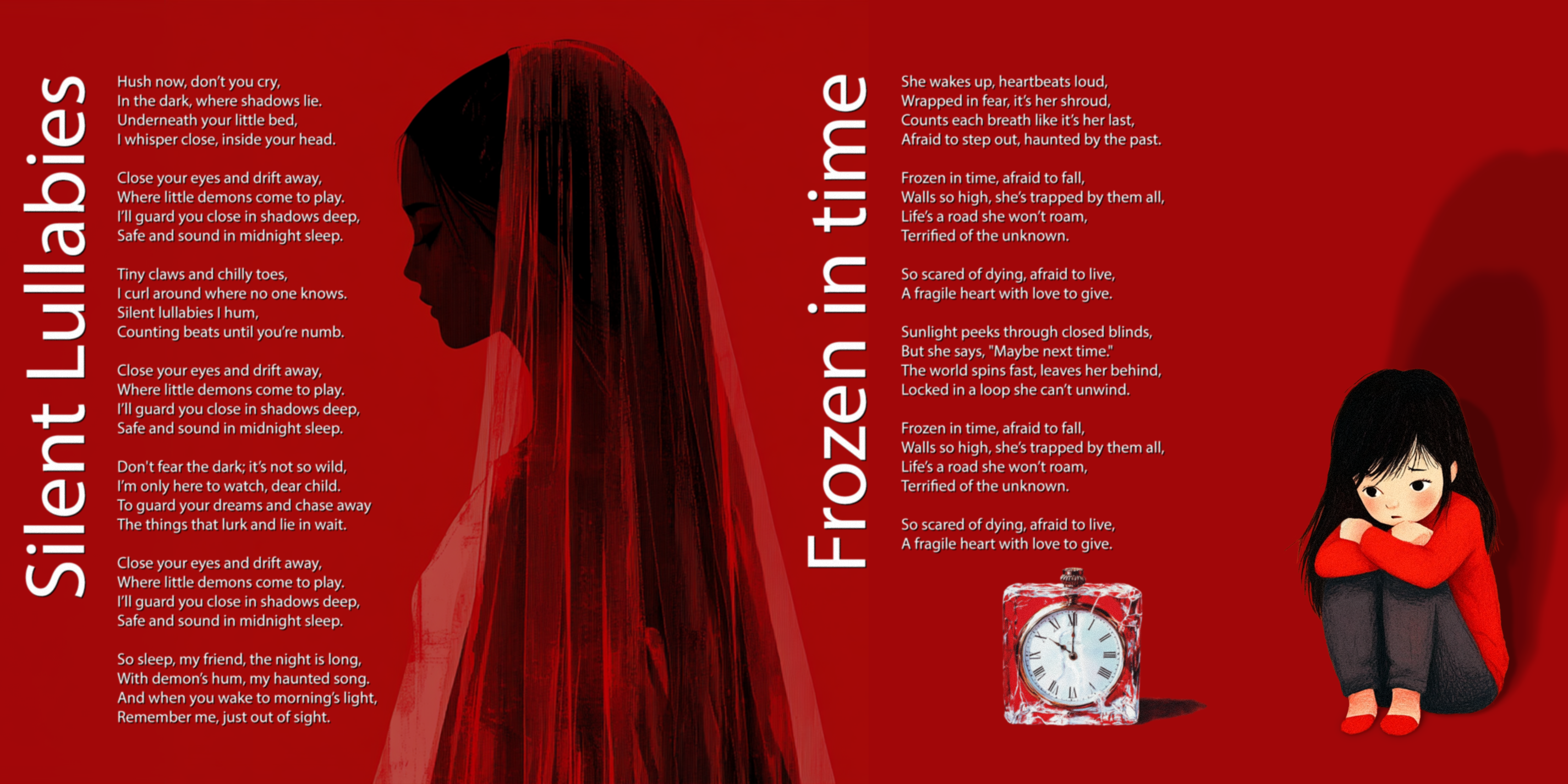
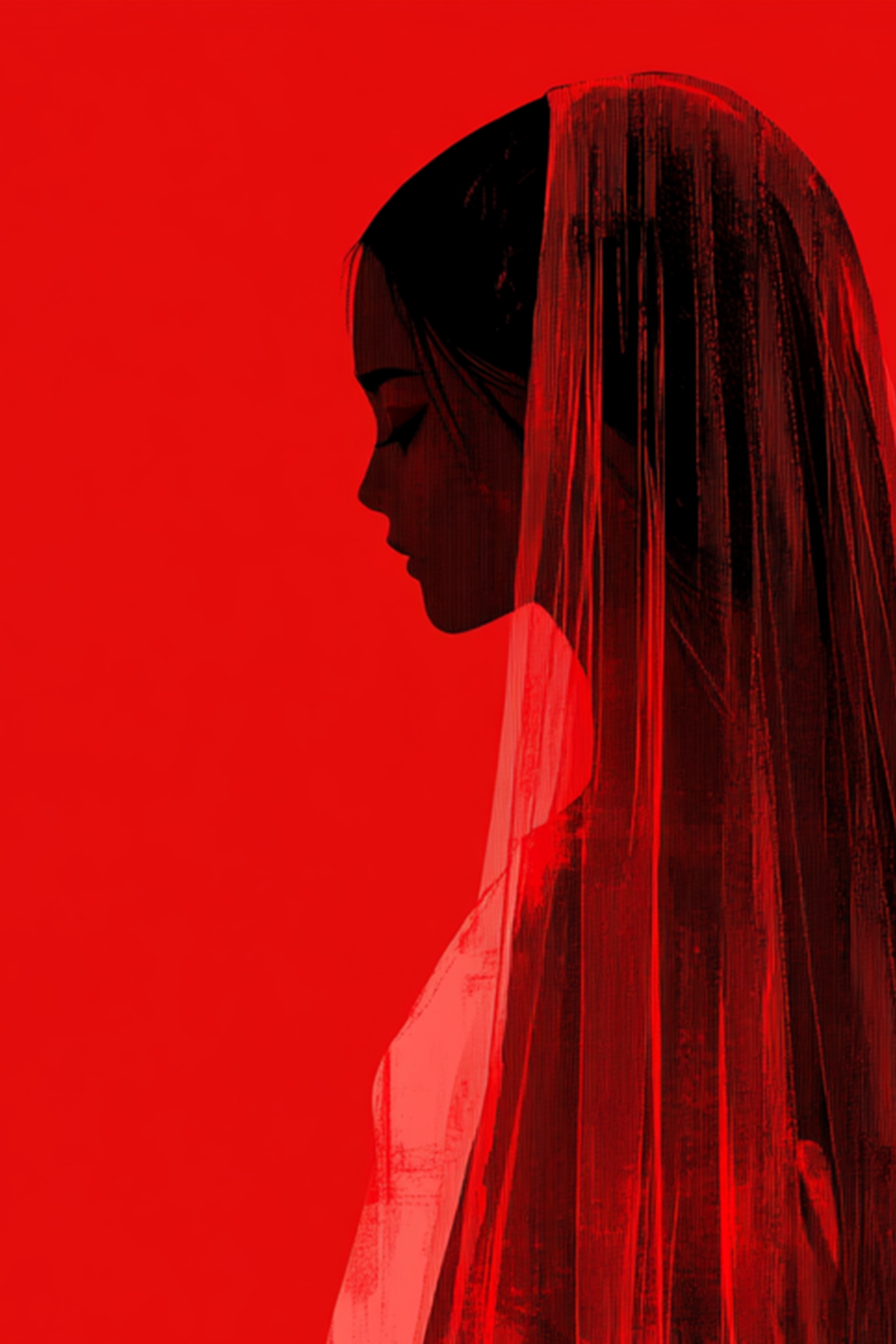
This image is a hauntingly elegant study in minimalism, emotion, and ritual. With a refined composition and a restrained yet powerful color palette, it presents a solitary figure—referred to as “The Bride”—suspended in a moment of profound stillness. Standing in profile and bowed slightly forward, the figure radiates a quiet solemnity, as if caught in a private ceremony, a silent prayer, or a farewell that has already been spoken but still echoes in the space around them.
The figure’s presence is delicate and composed. Their long, dark hair is neatly gathered beneath a translucent veil that flows softly down their back, shimmering faintly as it catches the ambient red of the background. The face is rendered with smooth, gentle curves, the downward tilt of the head evoking reverence, contemplation, or mourning. Beneath the veil, a gown or ceremonial robe can just be discerned—its form obscured by shadow and gauze, lending it an ambiguous air that straddles the line between bridal purity and funereal grace.
Surrounding the figure is a deep, saturated red that fills the entire frame—an infinite, textureless void. This red is not simply background; it is atmosphere, emotion, and context. Its intensity suggests passion and ritual, love and blood, life and death all at once. The figure seems to both emerge from and dissolve into this crimson sea, further emphasizing themes of transformation, sacrifice, or spiritual passage.
The veil, ghostlike in its softness, becomes a key symbolic element. It suggests ceremony, tradition, and the in-between—perhaps between worlds, between roles, or between life and afterlife. With no environment to ground her, the Bride exists outside of time and place, her isolation magnified by the vast nothingness that surrounds her. This creates a sense of mythic timelessness, as though she is both an individual and an archetype—a ritual figure embodying countless unseen stories.
Emotionally, the image carries a heavy stillness. It feels sacred, mournful, yet peaceful, like witnessing a final moment that will remain forever unspoken. The stark use of negative space and monochromatic harmony intensifies the emotional focus, allowing the viewer to linger in the quiet symbolism of the figure’s gesture and presence. With its minimalist beauty and quiet intensity, this portrait speaks volumes through its silence, leaving room for interpretation while enveloping the viewer in its solemn red dream.
THE STORY BEHIND THE SONG
Unveiling the Inspiration and Themes
“Silent Lullabies” was the song I almost didn’t write—because I thought it had already been written. Not by me, but by something else, something that lived in the folds of my memory and the corners of my room at night. I’d hum bits of it without knowing where it came from, like it had always existed, a bone-deep memory that was never really mine. It started as a dream, recurring and relentless. In it, I was always a bride—veiled, red, and waiting. The room was all white, but I bled through it like ink in water. There was never a ceremony, never a groom, just me standing there, silent and still, watching my reflection slip further away like it was being pulled under. Then nothing. A feeling of absence so complete it felt like death. That dream never changed. I saw it for years.
When I finally wrote the track for Rad Red, I remember thinking I was exorcising it—but I was wrong. “Silent Lullabies” wasn’t about getting rid of something, it was about making space for it. That bride, draped in crimson, wasn’t just a fear. She was me. A future I sensed but didn’t want. Womanhood, obligation, endings masquerading as beginnings. Everyone talks about the song like it’s a ghost story, and maybe it is. But the ghost wasn’t from my past. She was from my future—the one I never reached. She stood for all the things I thought would happen to me. A wedding, a transformation, a crossing over. But in that dream, the veil always fell, and there was nothing behind it but blood and silence. So I made her sing. I made her hum from under the bed and whisper through the walls. I gave her claws and lullabies and made her stay with me.
It’s strange how listeners say it sounds like protection. Maybe because when you’re young, danger and love feel like the same thing. That voice in the song—it’s mine, but it’s not. It’s a version of me I met too early, maybe too late. A guardian? A warning? Maybe just the last piece of myself I could still cradle like a child. After all, I never made it to the altar, never wore the white dress for real. But I wore it in every dream. Red soaked through it, every time. And then nothing. That’s how Silent Lullabies ends. Not with a scream. Not with a goodbye. Just a hush. Just the dark pulling me back, counting the beats until I’m numb.
– Cherry Ember, This Strange Endless Stage
Releases
Explore the full range of formats for this release, from timeless classics to modern editions. Whether you’re a collector or discovering it for the first time, find the version that suits your style:
-
- Compact Disc (1991) – The original CD edition for crisp, high-quality audio.
- Cassette (1991) – A nostalgic throwback with analog warmth, perfect for retro enthusiasts.
- 30th Anniversary Re-Release (2021) – A commemorative edition celebrating three decades, including remastered tracks and rare content.
- Digital Download (2016) – Instant access to the album in high-quality digital formats, compatible with your favorite devices.
- Vinyl (2018) – The classic listening experience on high-grade vinyl, featuring rich sound and collectible artwork.