
Rad Red III
Track Number: 15
Artist: Cherry Ember
Album: Rad Red
Year: 1991
Runtime: 3:46
Catalog (CD): SYNC91 00016-CD ALB-15ST US #T15
Digital: SYN91 00016-DD REI-35ST T15
Genre: Folk
BPM: 177
Mood: Empowering
Rad Red III
About
The final, most introspective chapter of Cherry Ember’s Rad Red trilogy, “Rad Red III” strips the concept back to its rawest emotional core. Released in 1991 on the Rad Red album, this acoustic ballad is more than just a sequel—it’s the resolution of a haunting, cyclical story that spans not just one lifetime, but the shared trauma and survival of many.
Performed almost entirely on a softly fingerpicked acoustic guitar, “Rad Red III” feels like eavesdropping on a memory. The song opens with the fragile, unmistakable sound of a young girl hurriedly hiding in a closet—a field recording Cherry claimed was a nod to her own childhood moments of fear and isolation. What follows is a deeply personal and metaphysical reflection on time, fate, and identity.
Where “Rad Red I” introduced us to the surreal, almost otherworldly space of the Rad Red, and “Rad Red II” expanded the mythology, this final entry feels like the closing of a circle. The lyrics tell of a girl navigating the liminal spaces between the past, present, and future, trapped in a moment where time collapses in on itself.
The chorus—“In the Rad Red, where moments collide / Where yesterday’s alive, and tomorrow won’t hide”—is devastatingly simple but powerful. It captures that unique Cherry Ember feeling of nostalgia mingling with dread, of wanting to both run from and cling to the past.
But there’s a shift by the end. The girl isn’t just hiding anymore. She becomes the “keeper of the clock, queen of worlds within,” no longer the frightened princess of her own locked tower but someone who has inherited the weight—and the wisdom—of survival. The final, faint sound of a child’s laughter as the song fades suggests peace, or maybe defiance.
In interviews, Cherry said “Rad Red III” was written as both a letter and a lullaby to her younger self, but also as a kind of hymn for anyone who has lived through darkness and found themselves holding stories that demand to be carried forward. It’s a song of lineage—painful, resilient, cosmic.
Though brief, “Rad Red III” remains a fan-favorite deep cut for its raw vulnerability and poetic finale to a trilogy that was never just about one girl’s life but about all of us who’ve ever hidden, listened, and eventually stepped out from behind the door.
VERSE AND CHORUS
Song Lyrics
In the corner of her room, shadows play on the wall
She’s drifting between worlds where the echoes call
She hears voices of her future, whispers of the past
It’s all here in her present, time frozen, held fast
In the Rad Red, where moments collide
Where yesterday’s alive, and tomorrow won’t hide
It’s all spinning around her, in a cosmic haze
The past, present, future—she’s caught in their gaze
And she’ll stay in the Rad Red, through endless spin
Keeper of the clock, queen of worlds within
Past, present, future—a strange world sown?
Album Artwork
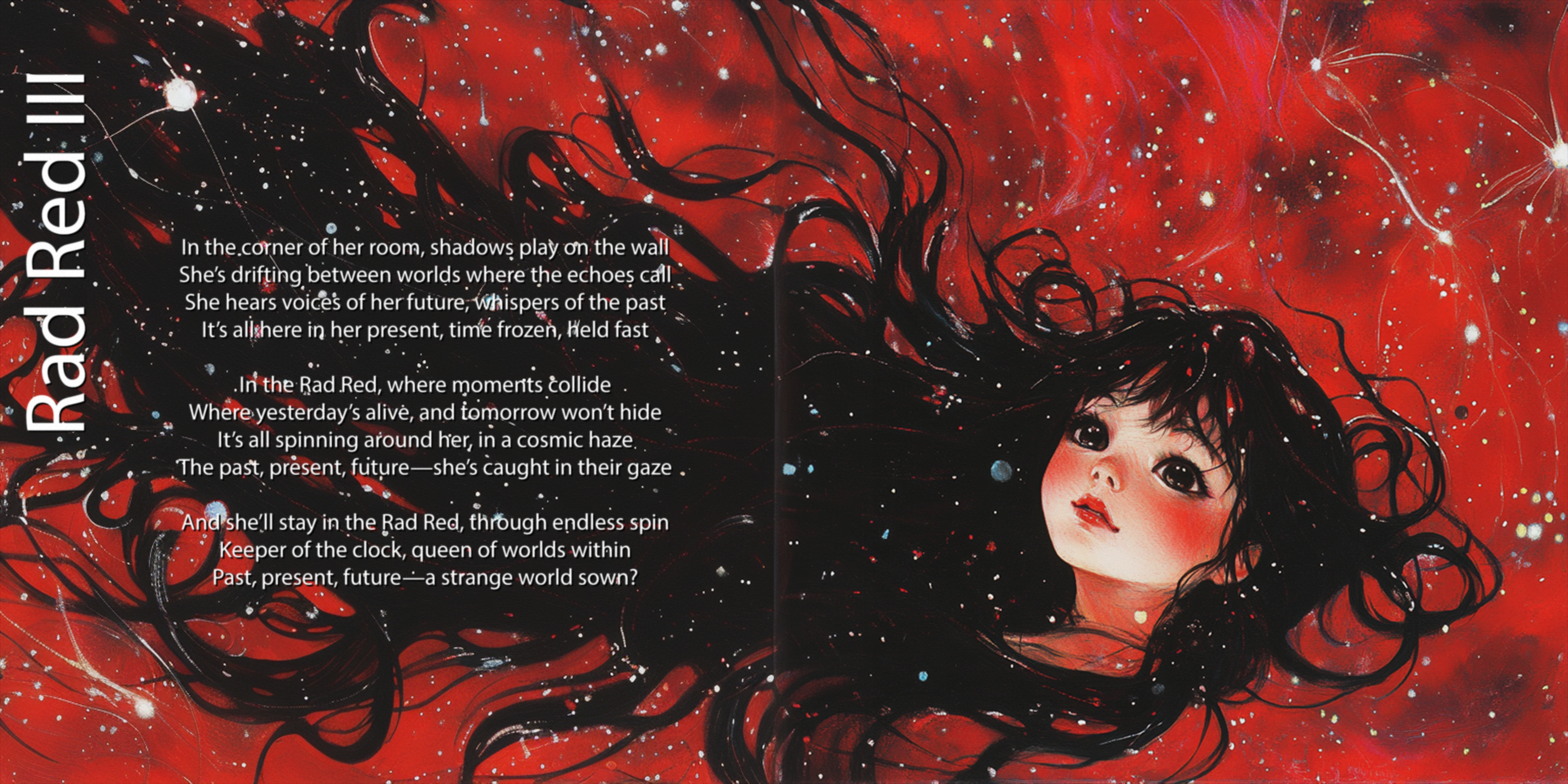
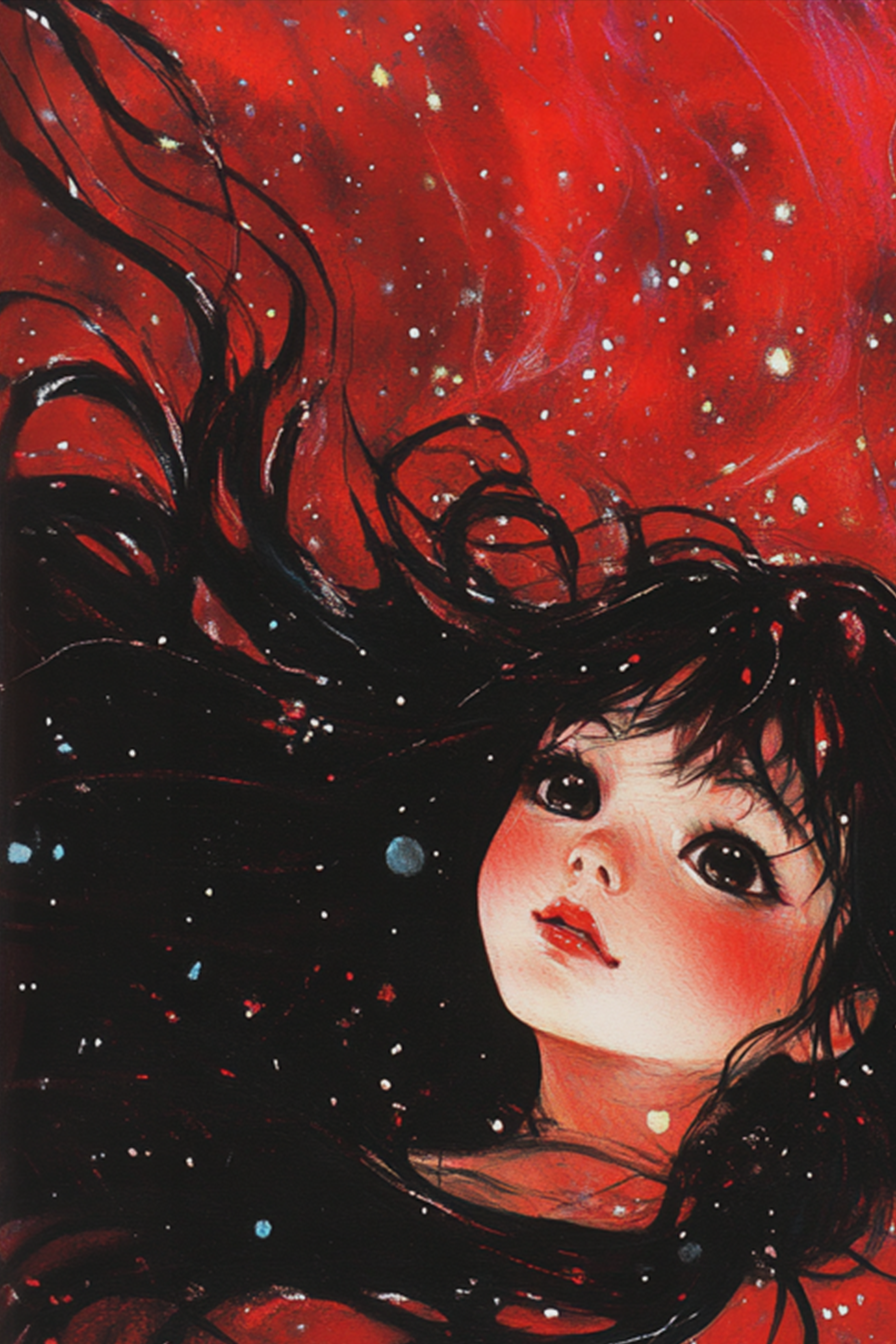
This image presents a surreal and ethereal vision—an atmospheric blend of cosmic wonder and quiet melancholy. Saturated in deep reds and shadowy blacks, it evokes a dreamlike sensation of drifting through a boundless universe, where beauty and loneliness entwine in silence. At the center of this celestial stillness floats the face of a girl, suspended in the right side of the composition, as if emerging from the fabric of space itself. Her body is unseen, either absent or hidden, leaving only her luminous face to gaze out from the darkness like a spirit adrift.
Her complexion is pale and porcelain-like, softly glowing against the surrounding sea of red. Her eyes are large and expressive, dark pools filled with distant light and gentle sorrow. There’s a wistful calm in her gaze, as though she’s watching something just beyond reach, or lost in a memory she can no longer name. Her lips are parted ever so slightly, painted a delicate rose shade, and a faint blush touches her cheeks—small signs of warmth that humanize her otherwise otherworldly appearance. She seems suspended in time, caught in a moment that neither begins nor ends.
Her black hair flows outward in a sweeping, cosmic current, stretching across the entire canvas to the left. The strands ripple like ink in water or smoke in slow motion, curling in tendrils that suggest both organic movement and celestial formations. Within the flowing locks, tiny white specks glimmer—stars scattered across a living night sky. Her hair and the cosmos are one and the same, an elegant metaphor for unity with the universe. Light traces drift between the stars like faint comet trails or whispers of stardust, lending the piece a soft momentum, as if space itself is breathing.
The background is rich with movement and mood. Deep crimson tones swirl with black shadows, ranging from ember-like glows to velvety darkness. There are no solid forms, no edges—only a vast, liquid sensation of space that feels both intimate and infinite. Dotted with glowing points of white and hints of bluish light, the scene radiates depth and mystery. Everything drifts—her hair, the stars, the light itself—creating a visual experience that feels like floating between dreams, weightless and unmoored.
Emotionally, the image is both tranquil and haunting. There’s peace in the stillness, but also a sense of loneliness—of a soul untethered, wandering through eternity. The girl’s presence, at once fragile and eternal, suggests themes of isolation, cosmic unity, and the quiet longing for connection. Her merging with the stars implies transcendence, as though she is dissolving into the fabric of space, becoming both memory and matter. It’s a visual elegy for something lost, or perhaps something becoming more than itself.
Stylistically, the piece draws from anime-inspired character design and cosmic surrealism. The detailed rendering of the girl’s face contrasts with the abstract, painterly textures of the background, anchoring the viewer’s focus while inviting them to drift with the scene’s broader motion. The limited palette—red, black, white, with hints of blue—intensifies the emotional impact, creating a cohesive and immersive visual meditation. It’s not just an image—it’s a feeling suspended in space.
THE STORY BEHIND THE SONG
Unveiling the Inspiration and Themes
I wrote Rad Red III as the final chapter in a story that had haunted me for years—a story that wasn’t linear, or clean, or even fully mine. It was a loop, a spiral of memory and myth I kept revisiting, trying to make sense of who I was, and who I had been. Where Rad Red I was a surreal confrontation with the unknown, and Rad Red II expanded that universe into something mythic and untouchable, Rad Red III was the reckoning. The quiet truth after the noise. Just me, a guitar, and the version of myself I used to hide from.
The opening sound—that rushed breath, the creak of a closet door, the hush of a frightened child—I didn’t add that for drama. That was real. I recorded it in an empty room late at night, chasing the feeling of being small and scared with nowhere to go but inward. That little girl? That was me. I used to hide like that, thinking if I was quiet enough, time would forget me. But time never forgets. It wraps around you. It becomes part of your voice.
Every line of the song was written like a letter I’d wished I could send back in time. “In the Rad Red, where moments collide / Where yesterday’s alive, and tomorrow won’t hide”—that was me trying to explain the way memory and fate had always chased each other in my mind. Rad Red wasn’t just a world I invented—it was where I went when everything real became too much. A place where my past selves could meet me halfway, and we could make peace, or at least speak.
By the end of the song, I had to let her—the younger me—know that we didn’t stay trapped. That we became something else. That she wasn’t just a girl in hiding, but a queen of her own fractured world. “Keeper of the clock” wasn’t just poetic—it was the moment I claimed my story, every jagged part of it. I needed her to hear that.
People often ask if the child’s laughter at the end means she made it out okay. The truth is, I don’t know. But she laughed. And that laugh still echoes in me. Rad Red III was my way of saying, You’re not alone in that room anymore. I’m here now. And we’re moving forward—even if we carry it all with us.
– Cherry Ember, This Strange Endless Stage
Releases
Explore the full range of formats for this release, from timeless classics to modern editions. Whether you’re a collector or discovering it for the first time, find the version that suits your style:
-
- Compact Disc (1991) – The original CD edition for crisp, high-quality audio.
- Cassette (1991) – A nostalgic throwback with analog warmth, perfect for retro enthusiasts.
- 30th Anniversary Re-Release (2021) – A commemorative edition celebrating three decades, including remastered tracks and rare content.
- Digital Download (2016) – Instant access to the album in high-quality digital formats, compatible with your favorite devices.
- Vinyl (2018) – The classic listening experience on high-grade vinyl, featuring rich sound and collectible artwork.